

So you’re three weeks in. Your seeds have popped, your seedlings are standing up, and now you’re staring at them wondering — is this normal?
Week 3 is one of those stages where beginner growers either breathe a sigh of relief or start panicking. The seedling looks small, it’s doing… something, and you’re not sure if you should be watering more, feeding, moving the light closer, or just leaving it alone.
Here’s the thing: a 3-week-old cannabis seedling is still fragile, but it’s also tougher than you think. At this stage, your job is less about doing more and more about doing the right things — and avoiding the classic beginner mistakes that stall growth or cause damage.
This guide walks you through exactly what a healthy seedling should look like at week 3, what the numbers should be (height, leaf count, watering frequency), what problems to watch for, and when it’s time to think about the next step: transplanting.
What Does a Healthy 3 Week Old Seedling Look Like?
Purpose of this section: This is the foundational visual and developmental benchmark section. Readers land on this post because they want to compare what they’re seeing to what’s “normal.” This H2 sets that baseline clearly and reassuringly for beginners. It also targets the core keyword and provides semantic depth around seedling development, cotyledons, true leaves, and vegetative stage entry — all entities Google associates with this topic.
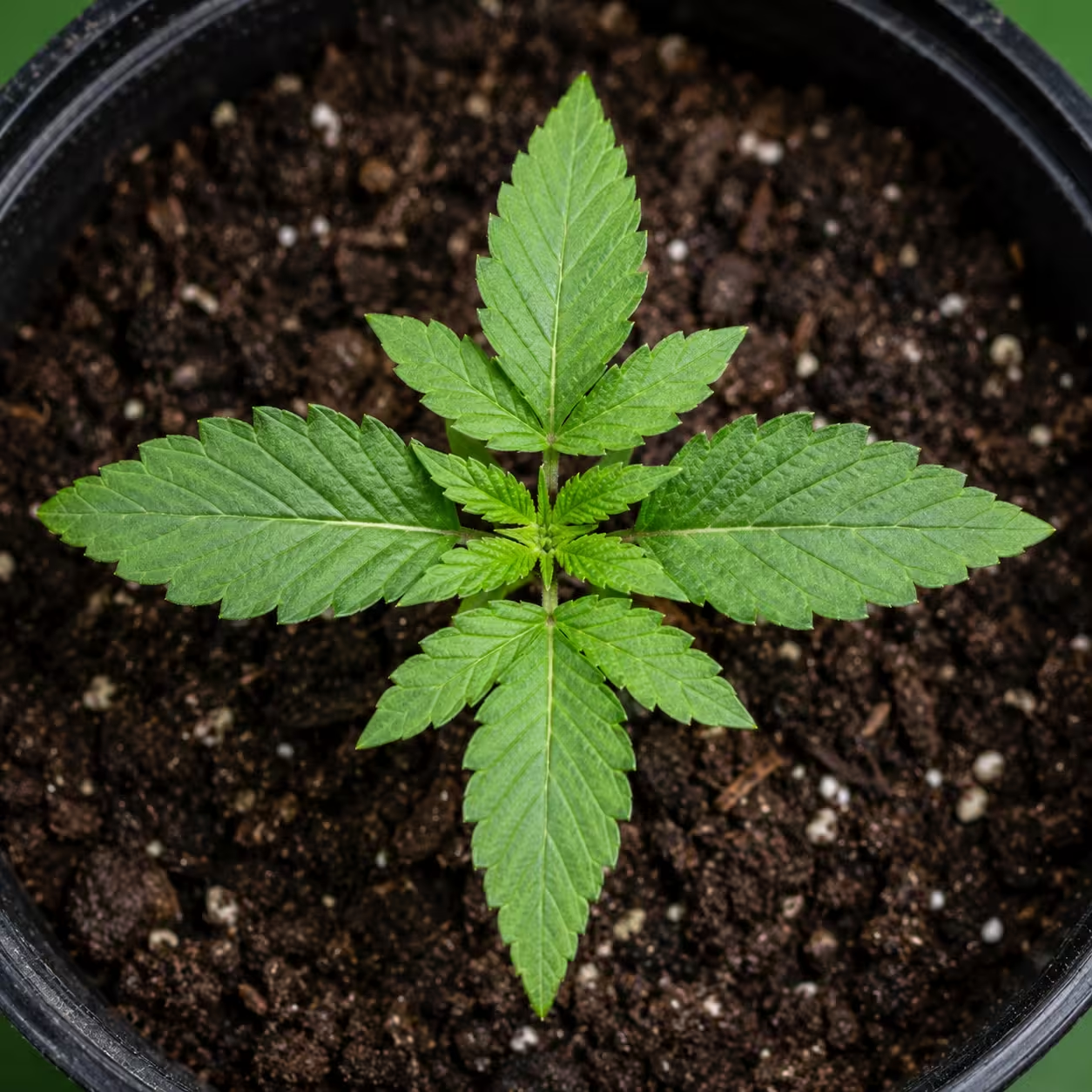
At three weeks from germination, your cannabis seedling should be showing clear signs of healthy vegetative development. Here’s what to look for:
Height: Most strains will be somewhere between 5–10 cm (2–4 inches) tall at week 3. Some sativa-dominant genetics stretch a little taller; indica-dominant plants tend to stay compact. If your seedling is taller than 15 cm with a thin stem, it may be stretching due to insufficient light.
Leaf development: By week 3, you should have moved well past the cotyledons — those first round seed leaves that pop up right after germination. Your plant should now be showing its first and second sets of true leaves, which are the recognizable serrated fan leaves that define cannabis. Most healthy plants at this stage will have 2–3 nodes developing.
Color: A vibrant, uniform medium-to-bright green across all leaves is the sign of a healthy seedling. The leaves should look firm and slightly waxy. Pale yellow-green or very dark green are both flags worth paying attention to.
Stem: The stem should be upright and self-supporting with some thickness at the base. A very thin, wobbly stem that can’t hold itself up is a sign of light-related stretching or underwatering.
Root development: You can’t see them, but by week 3 the root system is actively expanding through the growing medium. In a small starter pot, roots may even begin approaching the container walls — which is one signal that a transplant is coming up.
Cotyledons vs. True Leaves — What’s the Difference?
Purpose: Many beginners confuse cotyledons and true leaves. This H3 clears up a common point of confusion that appears in beginner forums constantly and helps establish the guide as genuinely educational, not just generic. It also naturally introduces semantic entities like “seedling stage,” “node development,” and “cannabis leaf anatomy.”
The cotyledons are the two small, oval, smooth-edged leaves that emerge first after germination. They’re not “real” cannabis leaves — they’re part of the seed itself, acting as the plant’s first energy source before photosynthesis kicks in.
True leaves look completely different. They’re the spiky, serrated, multi-fingered leaves that most people picture when they think of cannabis. Your first true leaves will usually have just one or three fingers (leaflets); later sets develop the classic 5, 7, or even 9-fingered structure depending on the strain.
By week 3, the cotyledons are usually still present but starting to yellow slightly as the plant’s energy shifts to true leaf development. That yellowing is completely normal — it means the cotyledons have done their job and the seedling is transitioning into its vegetative growth phase.
Node Count and Growth Rate at Week 3
Purpose: This H3 digs into the specific developmental markers (nodes, internodal spacing) that matter for understanding if growth is on track. It targets searchers asking “how many nodes should a seedling have at week 3” and related queries. It also introduces internodal spacing as a diagnostic tool — a concept beginners find immediately useful.
Nodes are the points on the stem where new branches and leaf sets emerge. Counting nodes is one of the clearest ways to track whether your seedling is developing at a healthy rate.
At week 3, most cannabis seedlings grown under adequate light will have 2 to 3 nodes fully formed, with the beginnings of a fourth node developing at the apical tip. If you’re seeing only 1 node by week 3, growth has likely been slowed by environmental stress — most commonly insufficient light intensity, temperature fluctuations, or overwatering.
Internodal spacing — the distance between one node and the next — tells you a lot about light. Tight, compact spacing between nodes means the plant is getting enough light and not reaching for it. Long, stretched gaps between nodes (sometimes called “leggy” growth) almost always point to a light that’s too weak, too far away, or on a photoperiod with too many dark hours.
Ideal Growing Conditions for a 3 Week Old Seedling
Purpose: Now that readers know what healthy looks like, this section tells them how to maintain it. It covers the four core environmental variables: light, temperature, humidity, and watering. This is one of the most searched areas around seedling care and allows for natural placement of key semantic entities like “grow light distance,” “seedling humidity,” “VPD,” “PPFD,” “vapor pressure deficit,” “cannabis watering schedule,” and “growing medium moisture.” It’s also highly practical — beginners will bookmark this section.
Getting the environment dialed in during the seedling stage pays off massively in the vegetative and flowering stages. Cannabis plants have a memory — stress at week 3 shows up as stunted growth at week 6. Here’s what your setup should look like.
Light — Distance, Intensity, and Photoperiod
Purpose: Light is the #1 cause of problems in seedling stage, and beginners constantly struggle with it. This H3 covers LED vs. fluorescent options, recommended distances, PPFD ranges, and the 18/6 photoperiod — all high-value semantic entities that help Google understand topical authority around indoor cannabis cultivation.
At week 3, your seedling is hungry for light but still sensitive to intensity. The goal is delivering enough photons for healthy photosynthesis without bleaching or burning young tissue.
LED grow lights: Most quality full-spectrum LEDs should be positioned 45–60 cm (18–24 inches) above the canopy at seedling stage. At this distance, your seedling is likely receiving somewhere around 200–400 PPFD (micromoles per meter squared per second), which is appropriate for this growth stage.
CFL or T5 fluorescents: These low-intensity options are popular for seedlings because they’re forgiving. Keep them 5–10 cm (2–4 inches) above the plant. They won’t produce enough intensity to cause light burn at close range.
Photoperiod: For regular photoperiod strains, run your lights at 18 hours on / 6 hours off during the seedling and vegetative stage. This gives the plant ample time to photosynthesize without the 12/12 trigger that initiates flowering. Autoflowering strains can handle 18/6 or even 20/4 throughout their entire lifecycle.
Signs your light is wrong:
- Stretchy, thin stem with wide internodal spacing → light too weak or too far
- Bleached or pale yellow leaves at the tip → light too close or too intense
- Purple or red hues on stem and leaves (without cold temps) → sometimes a sign of light stress or phosphorus lockout triggered by environmental imbalance
Temperature and Humidity — The VPD Sweet Spot
Purpose: Temperature and humidity are often discussed separately by beginners, but experienced growers know they work together through Vapor Pressure Deficit (VPD). Introducing VPD here adds genuine educational value, targets intermediate-adjacent searchers, and positions the blog as more knowledgeable than basic “keep it at 70°F” guides. Semantic entities: VPD, vapor pressure deficit, relative humidity, seedling microclimate, canopy temperature.
Cannabis seedlings thrive in a warm, slightly humid environment that mimics late spring conditions.
Temperature: Aim for 22–26°C (72–79°F) during your light-on period. Night temperatures (lights off) can drop 4–6°C without causing stress. If temperatures dip below 16°C (60°F), root development slows dramatically, even in an otherwise healthy seedling.
Relative Humidity: Seedlings absorb a significant amount of water through their leaves because their root systems are still developing. This means higher humidity is actually beneficial at this stage. Target 60–70% relative humidity for 3-week-old seedlings.
VPD (Vapor Pressure Deficit): VPD combines temperature and humidity into a single number that tells you how hard your plant is working to transpire. For seedlings, a VPD range of 0.4–0.8 kPa is ideal. High VPD (above 1.0 kPa) causes the plant to close its stomata to conserve water, slowing growth. Low VPD (below 0.4 kPa) can encourage mold and fungus gnats.
You don’t need to obsess over VPD charts at the seedling stage, but keeping your tent warm and your humidity up (a small humidity dome helps significantly in dry climates) goes a long way.
Watering a 3 Week Old Seedling — The Wet/Dry Cycle
Purpose: Overwatering is the single most common mistake beginners make, and it’s the #1 cause of seedling death and stunted growth. This H3 tackles it head-on with practical techniques (finger test, lift test, pot weight) and explains why the wet/dry cycle matters — in terms of root oxygenation and root zone development. Semantic entities: overwatering cannabis, underwatering seedlings, soil moisture, root zone, cannabis watering frequency.
If there’s one thing you take away from this entire guide, make it this: most beginners kill their seedlings with too much water, not too little.
A 3-week-old seedling in a small starter pot (roughly 0.5–1 litre) needs very little water. Its root system is small, and a soil medium that stays perpetually wet doesn’t have the air pockets that root tips need to grow into and absorb oxygen.
The wet/dry cycle is your framework. Water thoroughly until runoff appears at the bottom of the pot, then wait until the top 1–2 cm of soil feels dry before watering again. In most indoor environments, this means watering every 2–3 days for a seedling in a small container.
Practical tests:
- Finger test: Push your finger 2 cm into the soil. Dry? Water. Still moist? Wait.
- Lift test: Pick up the pot. A dry pot feels noticeably lighter than a wet one. With practice, you’ll know by feel.
- Observe the plant: Slight droopiness in the early morning (before lights on) is normal. Persistent, all-day drooping with dark soil almost always means overwatering.
Water quality matters too. Use pH-adjusted water at 6.0–7.0 for soil (ideally 6.2–6.5). Water that’s too acidic or alkaline locks out nutrients at the root zone, causing deficiencies that look like disease or pest damage.
Common Problems With 3 Week Old Seedlings (And How to Fix Them)
Purpose: This is the troubleshooting section — arguably the most search-intent-rich part of the entire post. Growers land on this type of content because something looks wrong and they need an answer fast. Each H3 targets a specific symptom-based search query and provides a clear cause-and-fix structure. Semantic entities across this section: nutrient deficiency, nitrogen deficiency, yellowing seedling, damping off, overwatering symptoms, light burn, cannabis seedling problems, root rot.
Something look off? Week 3 problems are almost always caused by one of a handful of issues. Here’s how to diagnose and fix the most common ones.
Yellowing Leaves on a 3 Week Old Seedling
Purpose: Yellow leaves are the most-Googled seedling problem, full stop. This H3 breaks down the three most common causes of yellowing at week 3 — overwatering, pH issues, and early nitrogen deficiency — and gives clear diagnostic clues for each. It’s designed to match “why are my seedling leaves turning yellow” type queries while staying natural and readable.
Yellow leaves on a young seedling almost always trace back to one of three causes:
1. Overwatering (most common): The leaves look pale yellow-green and slightly puffy or “clawed” (curling downward at the tips). The soil is consistently dark and moist. Fix: let the medium fully dry out before the next watering and check drainage.
2. pH imbalance causing nutrient lockout: If your water or runoff pH is outside the 6.0–7.0 range (soil), the plant can’t absorb nutrients even if they’re present. A seedling growing in plain, unamended soil with correct pH almost never shows deficiencies at week 3 — so if you’re seeing yellowing with correct watering habits, check your pH first.
3. Nitrogen deficiency: Older leaves (lower on the plant, including the cotyledons) yellowing and dropping off is a normal and expected process at week 3. But if your new growth — the true leaves at the top — is yellowing, that can signal nitrogen deficiency or pH-related nitrogen lockout. In seedlings growing in a quality seedling mix, this is rarely a nutrient problem and almost always a pH or watering issue.
Stretchy, Leggy Seedling at Week 3
Purpose: “Leggy seedling” is a very common search term. This H3 explains the etiology (light-related), the visual diagnostic (internodal spacing, thin stem), and the fix (lower/upgrade the light), along with a secondary fix (gentle stem support). Prevents readers from misdiagnosing a light problem as a watering or nutrient issue.
A seedling that’s tall, thin, and floppy with large gaps between nodes is called “leggy” — and it’s almost exclusively caused by inadequate light.
When the plant doesn’t receive enough light intensity, it goes into a kind of survival mode, prioritizing upward stem elongation to reach more light rather than building out dense, compact vegetative growth. The result is a plant that looks tall but is actually weak — thin stem, poor lateral branching, and a structure that’s harder to recover once it’s established.
Fix:
- Move your light closer to the recommended distance for your light type (see the light section above)
- If you’re using a weak light (old CFL, a random Amazon “blurple”), this may be a good time to upgrade
- If the seedling has already stretched significantly, gently mound extra soil around the base of the stem to provide support, or use a small stake and soft tie
Avoid the temptation to just lower the light dramatically overnight — do it gradually (2–3 cm per day) to avoid shocking the plant with a sudden intensity change.
Damping Off — The Fungal Seedling Killer
Purpose: Damping off is a serious and fast-moving problem that many beginners don’t recognize until the plant is already dead. This H3 covers what it is, what it looks like, causes (overwatering, poor airflow, fungal pathogens), and prevention. It’s a high-value educational section that builds trust. Semantic entities: Pythium, Fusarium, damping off cannabis, seedling stem rot, fungal disease.
Damping off is a fungal condition caused by soil-borne pathogens like Pythium and Fusarium — and it’s one of the few seedling problems that can go from “fine” to “dead” in 24 hours.
What it looks like: The stem at the soil line becomes brown, mushy, and pinched — almost like someone pinched it with their fingers. The plant collapses sideways suddenly, even when the leaves above still look green. By the time the plant falls over, it’s usually too late to save it.
Causes:
- Consistently wet, poorly draining soil
- Lack of airflow at the soil surface
- Using non-sterile growing medium (reused soil with live pathogens)
- Cold, wet growing conditions
Prevention:
- Always start in fresh, sterile seedling mix
- Maintain the wet/dry watering cycle
- Add a small fan for gentle airflow across the canopy and growing medium
- Avoid humidity domes once the seedling is 2+ weeks old unless your environment is very dry
- Some growers add a thin layer of perlite on the soil surface to prevent moisture buildup
There’s no reliable cure once damping off takes hold. The focus is entirely on prevention.
Nutrient Burn on Seedlings — Did You Feed Too Early?
Purpose: Nutrient burn is another very common beginner mistake — they add fertilizer too early and damage the seedling. This H3 covers the visual symptoms, explains why seedlings don’t need feeding in a quality mix, and sets realistic expectations about when to start a feeding schedule. Semantic entities: nutrient burn cannabis, seedling nutrients, when to feed seedlings, fertilizer, NPK.
Crispy, brown, or burnt-looking leaf tips on a 3-week-old seedling are often a sign of nutrient burn — and it almost always happens because a beginner added fertilizer too early.
Here’s the thing: a quality seedling mix or pre-amended soil typically contains enough nutrients to carry a seedling through the first 3–5 weeks without any additional feeding. The plant is small, its root system is limited, and its nutrient demand at this stage is minimal. Adding fertilizer on top of a pre-loaded growing medium can easily tip the root zone into excess nutrient concentrations, causing the tips to burn.
What it looks like: Brown, crispy, or “burnt” tips on the edges of leaves, starting with the tips and working inward. Unlike a deficiency (which starts with yellowing), burn starts at the extremities and tends to be uniformly distributed across the plant.
Fix:
- Stop feeding immediately
- Flush with plain, pH-adjusted water to dilute excess nutrients in the medium
- Wait until the plant is established in its vegetative stage before starting a diluted nutrient schedule (typically week 4–6)
When to Transplant a 3 Week Old Seedling
Purpose: Transplanting is the natural next-step question after week 3, and it’s a topic beginners search for heavily alongside seedling care. This H2 covers the visual cues for transplant readiness (root bound signs, growth plateau), the correct container sizing logic, and how to perform a safe transplant without shocking the plant. Semantic entities: transplant shock cannabis, root bound, container size, seedling transplant, root ball, transplanting cannabis seedlings.
By week 3, many growers start wondering: is it time to move this seedling into a bigger home?
The short answer is: maybe, but probably not quite yet. Transplanting too early can stress a seedling that doesn’t yet have a strong enough root ball to hold together. Transplanting too late causes the plant to become root bound, which stunts growth.
Signs Your Seedling Is Ready to Transplant
Purpose: Gives readers clear, observable signals for transplant timing — removing the guesswork. The goal is to help beginners feel confident making this call without stressing the plant unnecessarily. Covers roots, growth rate, and visual cues.
Look for these cues that your seedling is ready for a bigger container:
- Roots emerging from drainage holes: The most definitive sign. If you see white root tips poking out the bottom of the pot, the plant has maxed out its current container.
- Growth plateau: The plant was growing well but has slowed or stopped despite good conditions. This often means roots have circled the container and are limiting nutrient and water uptake.
- 3+ nodes fully developed: At this developmental stage, the root system is typically strong enough to survive a careful transplant.
- Soil drying out very quickly: If you’re watering more frequently than every 1–2 days because the medium dries out fast, the roots have likely consumed most of the available growing medium.
How to Transplant Without Causing Stress
Purpose: Step-by-step practical guidance on the transplant process itself. Addresses transplant shock — what it is, how to minimize it — and walks through the physical technique for a beginner. Semantic entities: transplant shock, hardening off, root ball, cannabis transplanting technique, transplant recovery.
Done correctly, transplanting causes minimal stress. Here’s the process:
- Water the plant lightly 1–2 hours before transplanting — not soaking wet, just moist enough that the root ball holds its shape when you remove it from the pot.
- Prepare the new container first. Fill the bottom of the new pot with fresh, lightly moistened soil. Create a hole in the center sized to match your current container.
- Remove the seedling carefully. Place your fingers around the stem at soil level, flip the pot gently, and let gravity do the work. The root ball should slide out intact.
- Place directly into the new hole. Don’t expose the roots to air any longer than necessary. Settle the root ball into the hole and fill in the sides with fresh soil.
- Water gently around the root zone. This helps the new medium make contact with the root ball and eliminates air pockets.
- Back off on feeding and light intensity for 2–3 days. A small reduction in light intensity gives the plant time to recover from any mild transplant stress before resuming full-intensity growth.
Most healthy seedlings show zero transplant shock when this process is followed carefully. If the plant droops for a day or two afterward, don’t panic — it’s usually just adjusting.
Feeding a 3 Week Old Seedling — Do You Need Nutrients Yet?
Purpose: A dedicated H2 on feeding because it’s a standalone topic that beginners frequently search for (“should I feed my 3 week old seedling”). Covers the logic of nutrient timing, what’s in a quality seedling mix, and when to begin a light feeding program. This is also a great place for semantic entities around nutrient schedule, NPK ratio, organic vs. synthetic nutrients, and seedling feeding chart.
Feeding is probably the most overcomplicated topic in cannabis cultivation for beginners. The short version: most 3-week-old seedlings don’t need to be fed yet.
Here’s why. When you plant a seedling into a quality commercial seedling mix, pre-mixed living soil, or even a standard potting mix with some perlite, that medium already contains a buffered supply of macro and micronutrients. The seedling’s small root system and low metabolic demand means it’s drawing from that reservoir at a slow rate.
Introducing additional nutrients — especially high-nitrogen synthetic fertilizers — into a medium that’s already loaded creates an imbalance that leads to nutrient burn, lockout, and a confused grower trying to diagnose a problem that didn’t need to exist.
When to start feeding:
- In a pre-mixed seedling soil: week 4–5, and start at 1/4 of the recommended dose
- In a very light or inert medium (coco coir, rockwool, perlite): nutrients may be needed as early as week 2, since there’s no pre-loaded nutrient supply
- In a living soil or super soil: you may not need to feed for the entire vegetative stage, as the microbial life in the soil does the work for you
What to look for before feeding:
- Upper leaves showing light green or yellow-green color
- Slowed growth despite correct light, water, and temperature
- Deficiency symptoms (typically affecting older, lower leaves first for mobile nutrients like nitrogen)
If none of these signs are present, hold off. A happy seedling in a good medium is telling you it has what it needs.
Quick Reference — Week 3 Seedling Health Checklist
Purpose: A scannable summary section that serves double duty: it helps readers quickly verify their own setup, and it’s a natural target for featured snippet capture. Google often pulls structured checklist content into featured snippets for “what should my seedling look like” type queries. It also provides a satisfying “wrap-up” experience before the FAQ.
Run through this checklist to confirm your 3-week-old seedling is on track:
Visual health:
- ✅ Bright to medium green color across all true leaves
- ✅ 2–3 nodes developed, with 4th node emerging
- ✅ Firm, upright stem with tight internodal spacing
- ✅ Cotyledons may be yellowing slightly — that’s normal
Environment:
- ✅ Temperature: 22–26°C (72–79°F) lights on
- ✅ Humidity: 60–70%
- ✅ Light: 18/6 photoperiod, correct distance for your light type
- ✅ pH of water: 6.0–7.0 for soil
Watering:
- ✅ Watering every 2–3 days (small pot)
- ✅ Soil drying out between waterings
- ✅ No standing water, good drainage
What you’re NOT doing:
- ❌ Feeding full-strength nutrients
- ❌ Watering on a rigid daily schedule
- ❌ Keeping the seedling in a perpetually wet medium
Frequently Asked Questions About 3 Week Old Seedlings
Q: How tall should a 3 week old cannabis seedling be?
Most cannabis seedlings reach between 5–10 cm (2–4 inches) by week 3. Sativa-dominant strains tend to grow taller with longer internodal spacing; indica-dominant strains stay more compact. Anything above 15 cm with a thin stem at this stage suggests light-related stretching.
Q: How many leaves should a 3 week old seedling have?
By week 3, you should see the cotyledons (still present or just starting to yellow), plus 2–4 true leaves across your first 1–2 nodes. The first true leaves often have 1 or 3 leaflets; later sets develop the 5 or 7-fingered structure most people associate with cannabis.
Q: My 3 week old seedling is not growing. What’s wrong?
Stalled growth at week 3 is almost always one of four things: overwatering, insufficient light, temperature stress (too cold), or a pH imbalance locking out nutrients. Check your watering frequency first (let it dry out more), then verify light intensity and distance, then check your water pH.
Q: Can I start LST on a 3 week old seedling?
Low Stress Training (LST) is generally best started once the plant has at least 4–5 nodes and a semi-flexible stem — typically closer to week 4–5 of vegetative growth. At week 3 from germination, the stem is often still too delicate for tying without risking breakage.
Q: Should I use a humidity dome on a 3 week old seedling?
Humidity domes are most useful during the first 1–2 weeks when seedlings lack developed roots and absorb most moisture through their leaves. By week 3, most seedlings have enough root development to be weaned off the dome — especially if your grow room humidity is already at 60%+. Keeping the dome on too long can invite fungal issues.
Q: My seedling leaves are pointing upward (“praying”). Is that good?
Leaves pointing upward at 45–60 degrees (sometimes called “praying”) is generally a positive sign — it indicates the plant is happy and actively photosynthesizing. Leaves that are pointing aggressively straight up at 90 degrees (heat stress) or cupping/clawing downward (overwatering/nitrogen toxicity) are warning signs.
Wrapping Up
Week 3 is a checkpoint, not a crisis point. If your seedling is green, upright, and showing new true leaf growth — you’re doing it right.
The most important things to take away: don’t overwater, make sure your light is close enough and strong enough, keep your pH dialed in, and resist the urge to feed. The seedling stage is about building a strong root foundation, not pushing fast growth. Give it the right environment and it will reward you with explosive vegetative development in the weeks ahead.
Got a specific problem you’re seeing that’s not covered here? Drop it in the comments — this community has seen just about everything.
Related reading: [Cannabis Seedling Stage: Week 1 and 2 Guide] | [When to Top Cannabis Plants] | [Vegetative Stage: Week-by-Week Growth Guide]
